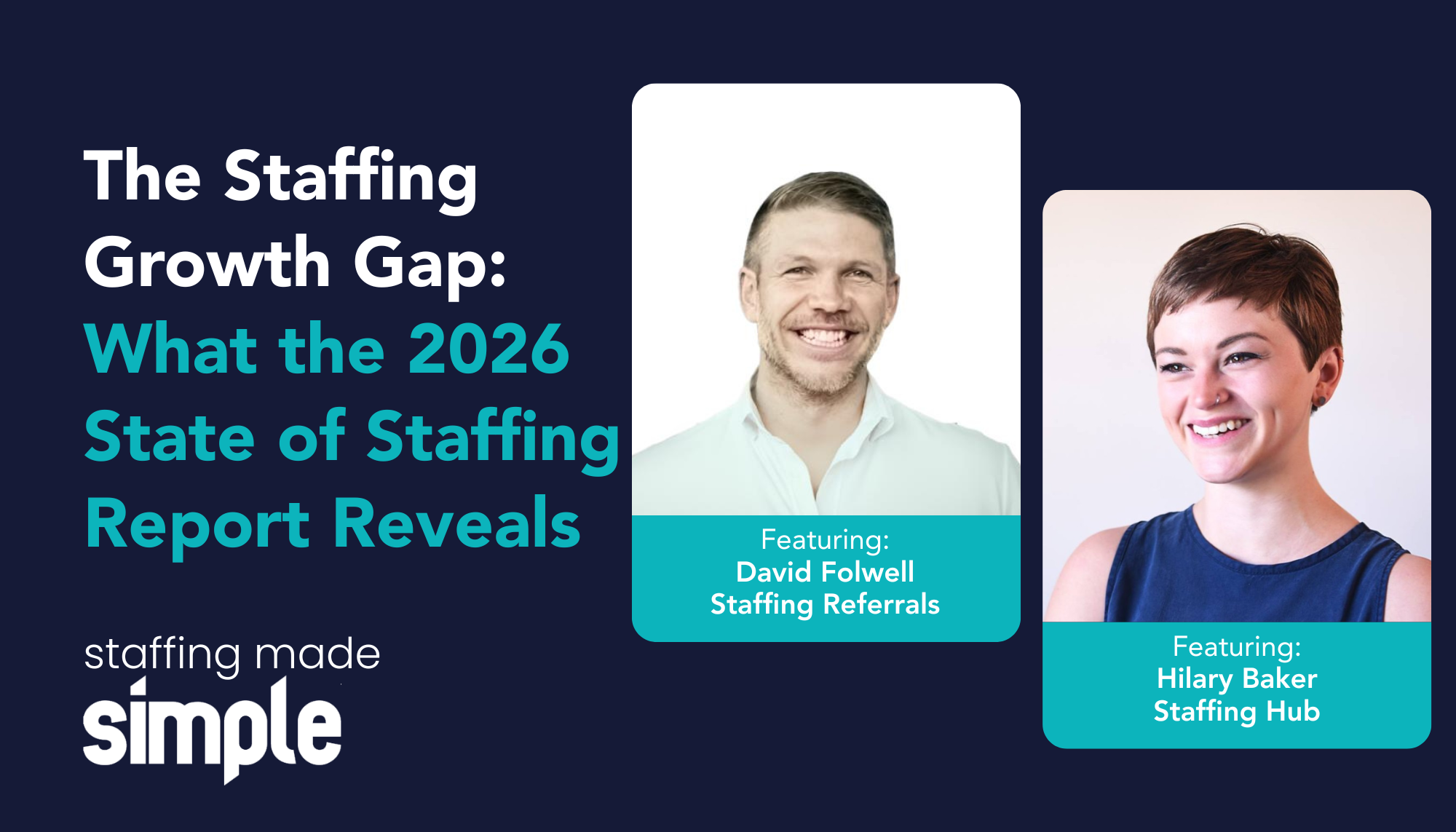
The Staffing Growth Gap: What the 2026 State of Staffing Report Reveals
The staffing industry has faced a tough couple of years, but not every agency is feeling the pressure in the same way. Some firms are still growing, while others are struggling to gain traction. So what’s separating the two? In this episode of Staffing Made Simple, we dig into the 2026 State of Staffing Benchmarking Report to uncover what the numbers really say about the state of the industry and what the highest-performing firms are doing differently.
Co-hosts Casey Wagonfield and Rob Geist are joined by David Folwell, President and Founder of Staffing Referrals and Staffing Hub and host of The Staffing Show, and Hilary Baker, Managing Director of Staffing Hub. Together, they unpack the data behind the report, including what’s driving growth, how firms are using AI and technology, why reliance on job boards is shifting, and what the industry’s strongest performers can teach staffing leaders looking to grow. Because the numbers don’t just tell us where staffing stands today. They show us what the firms pulling ahead are doing differently.
Casey Wagonfield
The staffing industry has been through a pretty challenging couple of years, but not every agency is having the same experience. Some firms are still growing, and when you dig into the data, there’s some pretty clear differences in what those agencies are doing. Today, we’re breaking down the 2026 State of the Staffing Benchmarking Report and looking at the numbers and what they actually tell us about the industry right now.
We’ll get into what’s driving growth, where agencies are struggling, how AI and technology are actually being used, the shift away from relying so heavily on job boards, and what the highest performing staffing firms seem to be doing differently
There are a lot of numbers in this report, but more importantly, there’s some really good lessons staffing leaders can actually use.
So let’s get into it.
Hey, everybody. Welcome back to another episode of Staffing Made Simple, brought to you, as always, by Simple VMS, who put the vendor in VMS, and my personal favorite, the VMS without the BS. I’m Casey Wagonfield, long time in the industry, over 16 years, so I’ve seen just about all of it. We’ve got a really good one today.
We talk all the time on this show about what staffing companies think is happening in the market, and today we actually get to look at the data. So again, we’re gonna be digging into the 2026 State of Staffing Benchmarking Report. So, what stood out, what the firms that are growing are doing differently, and hopefully pulling some things out that staffing leaders can take back and actually use in their business.
As always, I’m here with my buddy, my co-host, senior vice president at Simple VMS, a man that has a wealth of knowledge about the staffing industry and VMS, and also a man who is changing the game when it comes to fashion in the staffing industry.
You know him, you love him. Mr. Rob Geist. What’s up, Rob?
Rob Geist
We were just at the Avionte Connect Conference, and my pearl necklace that I’ve been rocking did get a lot of attention. Joining us today is David Folwell. He’s president and founder of Staffing Referrals, something every staffing agency should be using. He’s the founder of Staffing Hub. David also is the host of The Staffing Show and has spent years studying the strategies, technology, and trends impacting staffing firms.
We’re also joined by Hilary Baker, managing director of Staffing Hub. Hilary works right in the middle of the research, content, and conversations in Staffing Hub. She’s talking to all the leaders throughout the country. David, Hilary, thank you so much for joining us. We’re excited to dig into the report with you.
David Folwell
Excited to be here with you.
Casey Wagonfield
You know, and David, I think I saw you a couple times from afar at Connect, but I don’t think we actually got to talk. There’s hundreds of people there, and I think you were always in a conversation.
David Folwell
Seeing both of you on camera today, I’m like, I don’t think we barely said hi. I was completely slammed, just running in different directions .
Casey Wagonfield
David, we can take a hint. It’s all right. You guys were both there at Avionte Connect this year. Was there anything that stood out while you were there, and anything, I guess, you heard or saw that lined up or maybe challenged what you found in the state of staffing report?
Hilary Baker
Yeah, I can start off. For the first time in a couple of years, we heard a lot of really genuine optimism and excitement about where the industry is headed, and that was a real and very welcomed shift to feel that energy in the room again. And the other thing that we heard a lot about, obviously you cannot go one conversation without hearing about it, was AI.
You can tell people are now moving into curiosity mode. They’re curious about how AI can have the biggest positive impact on their business. They’re asking their peers about use cases. They’re listening to how others are using it. They’re taking notes like crazy, and they’re really just starting to wrap their heads around the possibilities of what AI can do for them.
And the last thing that I’ll mention that I heard a lot about was responsible AI use as well. We’re moving past the do I need to implement this into how can I implement this, and how can I implement it in the most responsible way possible? And that conversation is happening really, really fast and changing really, really rapidly.
Rob Geist
I love to hear that. It kind of just echoes everything that we hear at all the different conferences that we go to. So, it’s good to hear somebody who knows what they’re talking about actually, solidify that that’s what’s going on. So, Hilary and David, for those who haven’t had a chance to look at the report yet, what type of staffing industry professionals took part in this year’s research, and what were you hoping to learn from them?
Hilary Baker
Yeah. So this year we had 231 respondents to our State of Staffing survey that we took back in January. Roughly three quarters of those respondents were director level and above. Half of the respondents are executives, so we really are looking at the operators and decision-makers at these staffing firms.
As far as company size goes, 45% of the agencies were under 10 million, and about a quarter were 50 million or more. And the majority of our respondents come from industrial and logistics, IT, and healthcare. We’ve been running this survey and putting out the report for nine years now. It’s kind of crazy to think we’ve been doing this for that long.
But, every year since 2018 we’ve covered the industry through the pandemic, the boom, and now the current kind of correction, which is making the year-over-year benchmark something really interesting to look at.
Casey Wagonfield
Pretty cool to see even after the past nine years. What was the difference in year nine when we started doing this versus now?
I’m sure the questions and everything’s changed dramatically since then.
David Folwell
Yeah. It’s been really fun. I mean, our goal when we started it, I’m just a curious person. I love data. I love trying to figure out what’s going on in the market, and so it’s been, how can we understand what’s working, what’s not working, what’s gonna help companies drive growth?
And, from day one, we were really segmenting the survey data by the fast growth, low growth, and then trying to figure out what’s the operating system for the people that are doing it one way versus the other, really with the ultimate goal of, how do you avoid the mistakes that people are making?
How do you do the things that are working, and how do we continue to deliver that information to the industry? And gosh, I think what’s happened is we’ve added 40 questions. So, it keeps getting bigger, but more insightful and deeper knowledge.
Casey Wagonfield
Yeah. That’s great. And before I guess, we get into the specific findings, anything about this report or this year that stood out where you’re like, “You know, we didn’t expect that”?
Hilary Baker
The biggest surprise to me was that the response speed race seems to be over. For a long time it was like fast growth, agencies are responding to leads faster, they’re responding to candidates faster, but now that is clearly not a differentiator. It’s more table stakes. So, I thought that finding from this year was pretty interesting.
David Folwell
And I’d add one of the basic and kind of fundamental things that you hear it and you’re like, “Oh, of course,” but one of the key findings was that agencies that are focused on operational discipline are winning. Your sourcing mix matters, not just focusing on referrals or whatever it is, but actually being strategic and having a multi-channel sourcing approach where you’re trying different channels and measuring what works.
And one of the stats that kind of blew my mind. I still can’t believe that this came back, but 48% of agencies do not track redeployment rates, and that just seems wild to me knowing how impactful that can be on your business.
Casey Wagonfield
Yeah, that low-hanging fruit, right? Redeploy them. They’ve already done a good job .You have them.
David Folwell
Yeah. Yep.
Rob Geist
Well, and one of the not so surprising takeaways from, the report is the connection between AI adoption and growth, and the agencies who aren’t using AI were much more likely to contract. What do you think is really behind the gap, and where do those high growth agencies use AI?
Is it sales, recruiting, operations, or just across the board?
Hilary Baker
When we looked at the survey findings, we looked at how many processes the operators who answered had put AI behind or into, and we separated them by heavy users, moderate users, and light users or adopters. The light adopters, they use it for one to two processes, moderate three to four, and heavy five or more.
And what we found is that these deep and heavy AI adopters were more than twice as likely to be in a growth agency than those who were using none. And 39% of heavy adopters and 38% of moderate adopters were in the growth category. Only 17% of people who were not using AI at that time were in the growth category. That gap is very apparent, very real, and I believe that it’s widening quicker than we might realize because, full transparency, this data’s from January.
So much has changed so quickly since then. Tons of new models, new tools have come to market. Lots and lots of new capabilities. Faster, they’re smarter. So many things have come to light since then, and I think that if we were to measure the same thing today, there might be even more of a stark gap at what we were seeing back in January.
Casey Wagonfield
Yeah. It seems like it’s changing daily, the AI game, and I can believe that, right? The more heavily adopting you are of it, we see that here at SimpleVMS, as we put in more AI, it just creates efficiencies and you can focus on other things, so.
David Folwell
Yeah. And, I think there’s one point here when you talk about adopting AI, a lot of people are like, “Oh, well, we’re adopting it,” and everybody has ChatGPT or everybody has access to Claude, so we’ve adopted it. And I think that it’s really important when you think about adoption. A good way to put a line in the sand on like, are we adopting it or are we actually improving processes is: do you have a named process?
What is the skill or day-to-day activity that has been replaced by this use case for AI, and are you measuring the outcomes and the output from AI? And I think that’s where we really start to see the operational gains, the improvement on gross profit, the improvement to your bottom line, and it’s pretty simple when you start talking to an organization.
It’s, what process have you replaced with AI, and what is the outcome, the time savings, the actual ROI that you’ve seen from that? And I think that’s the difference between, using AI and actually having it operationalized, and it’s where I think we’re going to start seeing the companies that are taking it to that next step, and they’re looking at, “We’ve got a list of 20 processes, and we’re going one by one to look at where we’re gonna be putting AI in place.”
That’s where they’re gonna start to see significant operational gains over time, and there’s a lot of companies that are looking at it from that perspective.
Rob Geist
The thing internally here at Simple, I lead the sales team, and my sales director started using AI to help our reps ramp faster because it’s a long ramp for my reps.
You have to learn the software, you have to do everything and learn how to demo, and she’s automated that out and we test people on how well they’re demoing before we kind of let them run out there in the wild. So, I think it’s sometimes important to talk about specifics of what people are actually doing with it.
You hear these conversations, but they’re just so nebulous, right?
David Folwell
Yeah. And on the specifics, I think what is the most transactional thing you can do that’s repetitive? If I was running an offshore business, I’d be a little scared right now because I think that a lot of the stuff that goes offshore is starting to look at people like, “Can we do that with AI?” Some of the transactional, easiest wins are the repetitive tasks that are the lower, skill set, or take less effort.
So, I think that sourcing or, qualifying up at the front where people are coming in, they apply to a job and you’re like, “Well, I need to know these five questions to see if they make it to the next step.” That’s the type of area where we’re seeing huge impacts and seeing companies adopt it really fast.
Also, on the back office, we’re starting to automate accounting and finance processes and looking at where can we connect these dots? ‘Cause they’re rote tasks that happen the same way every week. That’s like the perfect use case for it.
And then, I’m obsessed with comes to the sales use cases and sales transcription and then, coaching from that is something that we’re seeing big adoption on and also a bigger impact, a little bit harder to measure, but, we are hearing improvement in ramp speed of, what used to take a month to get somebody up to speed and 10 hours of a manager’s time is now two hours and a lot faster.
Rob Geist
We do the same thing. We use Gong internally for what you were just speaking about.
Casey Wagonfield
That’s great. And , I think companies are starting to realize now that just because you use ChatGPT to write your emails doesn’t mean you’re using AI, right? There’s so many complex ways to use it that people just don’t understand. And, I know you mentioned a huge part of the report was around operational efficiencies, and that really stood out.
So, the agencies that track KPIs and have consistent processes tend to grow faster, but at the same time, a lot of agencies still struggle to answer basic questions about the ROI of a new process or technology. Why do you think the gap between knowing what to measure and actually doing it is still so big?
David Folwell
I actually think it’s just because measuring is boring and buying is exciting. Everybody likes to look at a new shiny tool. Nobody wants to show up every Thursday to go over the numbers and report what they did well or didn’t do well.
And so, I think it goes back to the operational discipline and operational rigor. And I think when it comes to measuring ROI, there’s a lot of people that are doing it well, but I think it can be hard to understand and track the time savings or the full impact of what you’re buying.
And that’s why a lot of the measurements get placed on job boards because you can look at, well, here’s what we paid, here’s what we got. But then when you look at everything else in the industry, there’s some fuzziness to it, and it makes it harder to have a clear idea of what the ROI is unless you spend a lot more time upfront on the planning and decision-making for what an ROI would look like
Hilary Baker
Something to add to that too is I think a lot of the focus goes into measuring some of the things that are client facing or that clients will ask you directly about, like fill rate or time to fill.
And the measurement on things that could drive more business strategy are lacking, things like NPS, redeployment, like we were talking about, tech budgets. Some people aren’t even tracking gross margins, which is crazy. And I know Dave said part of this is because measurement is a little bit boring.
I think people know that they should be measuring things, but they’re not for whatever reason. And a lot of these data points may also just live in disconnected systems, which can make the barrier to entry to effective measurement higher
Rob Geist
That’s super interesting. And then something, Hilary, that you just mentioned, and I think David actually spoke of it, at the beginning, is redeployment and how a smaller number than I thought, are actually measuring that, and the ones that do see a real impact in growth. So what should agencies be looking at when it comes to redeployment? What are the best performing agencies doing differently with that information?
Hilary Baker
So, this was a genuinely surprising finding in the report.
48% of our respondents said that they are not sure of or they don’t track their redeployment rate. And, the reason why this was so shocking to me is because redeploying your talent pool is one of the most underutilized levers that you can use to cut down on your sourcing costs. So, why the heck are you not measuring it?
The only metric that is more neglected than this is NPS at 67%, which is also kind of insane. I think that agencies are just so organized and operationalized around sourcing the next fill by whatever means necessary as quickly as possible, and not focused on filling it from the talent that they have already placed and have access to.
They need to be paying attention to this because it is so much more efficient on so many fronts to place people from your existing pool versus paying for talent twice. It doesn’t make much sense.
Casey Wagonfield
I used to say it all the time: why do we keep posting and praying when we got a million people in the database that we could be reaching out to? And I noticed the sourcing mix also seems to be changing too, right? The agencies that are growing the fastest are, relying less on the job boards and more on their own databases, referrals, and career sites.
Why do you think we’re moving away from that traditional job board model, and what does a really strong owned sourcing strategy look like today?
David Folwell
The thing we’re seeing as an overall trend is staffing firms are, one, trying multiple channels. They’re measuring the cost per hire by channel. The more advanced firms are measuring candidate lifetime value by channel, which is giving them the overall gross profit that they earn on a placement from each different source.
So for example, what we typically see is, let’s go candidate lifetime value. We’ll use some real numbers, in travel nursing, do 1.2 assignments, we’ll say, if they’re placed from Indeed. If they’re placed from a referral, we’re seeing like 1.6 assignments on average.
And so, what the difference really is, is that the source of the channel actually drives the quality of the hire, and your owned networks are more valuable than the rented networks. And so the trend we’re seeing with the people that are measuring this well, is they’re trying to figure out how to get more out of their database, so they’re doing kind of a network sourcing or direct sourcing.
They’re trying to get more referrals, so they’re putting referral software, referral automation on top of it. And then they’re also doing the redeploy campaigns. But it’s really about how to get the most out of the most profitable channels, and simultaneously, not only are you getting higher quality talent when you do that, you’re also reducing other costs.
So, it’s kind of a win-win, and that’s one of the key trends, is getting a little bit more modern and marketing focused when they look at how they’re approaching sourcing.
Rob Geist
I also saw some early data around apply to place rates, something like 17% for referrals compared to just 1% with job boards.
What does that tell agencies about where they should be putting their sourcing dollar and effort?
David Folwell
Yeah, this is funny as this goes back to our ROI conversation. It’s not only are you getting somebody who’s going to redeploy, stay on contract longer, redeploy at a higher rate, you’re also spending an incredibly, fewer amount of hours on sourcing that candidate.
If you’re getting somebody from a, job board, one out of 100 resumes, think about how how many interviews you have to do, how many resumes you have to look at versus a referral and you know that, there 17 times more likely to get placed on assignment versus a job board candidate
Casey Wagonfield
Yeah.
One thing I noticed, I think you mentioned this earlier at the beginning, that speed to respond, used to be a major competitive advantage, and now most agencies are just doing that now. So, like you said, it’s just table stakes now. So with that said, what are the high growth agencies doing that others aren’t?
Hilary Baker
Yeah. We’ve touched on this, in a couple of different ways, but they’re really putting a lot of focus into operational rigor within their organizations, and it sounds like such a foundational thing, and it is. But just meeting with your team on a regular basis, having owners of scorecards and owners of metrics to make sure that they’re moving in the right direction, all of these very foundational things are what are correlated with higher growth.
And then, obviously the strategic AI adoption. And the reason why I say strategic is because, like you guys said earlier, people can say they have adopted AI if they’re using ChatGPT or Claude to draft their emails. And while that’s great, it’s a really good entry point and a way to learn about it, I wouldn’t say that it is a strategic adoption of AI.
The folks who are growing more rapidly are going to be the ones who are thinking about things like, “Okay, what are the processes that are going to get the most ROI out of AI adoption? What are those high volume, low risk things that I can point my technology at right now that can move the needle today?”
And then of course, the owned sourcing mix was the other thing that we found that high growth agencies, fast growth agencies were doing differently.
Rob Geist
So, guys, landing new clients came through as the number one challenge for agencies. You look at strategies for the high-growth agencies, things like operational discipline, strong redeployment, more diverse sourcing mix, how can agencies turn those strategies into a competitive advantage when they’re out there selling?
David Folwell
One of the things we’re seeing our customers do, and we’re hearing more conversations around this, Dan Mori talks about this quite a bit, is using your talent pool as a differentiator. I think that one of the competitive advantages in the future is gonna be saying, “We give you access to this qualified, verified talent pool that you don’t have access to through job boards.”
And then I think it’s important for agencies to know their data, know their redeployment rates, and be able to speak to how their talent pool performs compared to other talent pools. That really is the way that I see it. The product you are selling is access to your talent, and if you can say, “When you hire through us, they stay on contract fifty percent longer,” you have something that is different from the competition, so I think it’s important to know that data.
Casey Wagonfield
And you may have even just answered the next question, David, to be honest.
‘Cause I was gonna ask, once an agency has strategies in place, how do they prove their value to a prospective client, You can go out there and say, “We have great operational discipline, and we redeploy a lot of people.”
David Folwell
Yeah.
Casey Wagonfield
Right? Like, but a lot of people might be saying that.
David Folwell
Yeah. We have the best talent.
Casey Wagonfield
Right. We respond really quick, and people love us. But how do you make that quantifiable to a prospect when you’re talking to them?
David Folwell
You know, this is from conversations I’ve had with people on my podcast. A few different kinds of thought leaders, people that are adopting tech really rapidly are talking about how the future of staffing is actually really deep transparency of having visibility into all of the talent that we’re sending your way through a dashboard.
One of the customers that we have is actually giving them a full dashboard of every candidate and where that candidate came from. So, you can see the full sourcing strategy, what effort’s going into it, what work is going into it, and see how they’re kind of finding the right candidates for them.
So, I think that it’s going to be, not just saying it, but actually giving your clients tools to show that you’re doing the thing you said you can do. And I think right now, where companies are starting to approach is QBRs or EBRs, where you’re doing a regular review. You’re showing them the data.
You’re saying, “Here’s what we did. Here’s what worked. Here’s what didn’t. Here’s where we might be able to lower cost,” and really showing up more as a partner in the client meetings. But I think the next phase of that is, you’re there being fully transparent about what you’re doing and the services you’re offering and then giving them full visibility into that so that they can see the work that’s going into it and also, recognize, what’s working for them and what’s not.
Casey Wagonfield
Yeah, not to get too off track, just reminded me we had so many conversations at Avionte Connect about being able to offer something, being a consultant, right? And we talk to agencies about how they can partner with SimpleVMS to add it to their back pocket as a prospecting tool. If you’re going to somebody and they say, “We’re using 12 agencies,” how do you manage all of them, right?
Be somebody that’s gonna show them the metrics. A tool that will show them the time to fill, time to submit, turnover percentage, things of that nature.
David Folwell
It just goes back to being consultative.
You should be there to help your customers, and the transactional approach to business has been slowly declining for a long time, but I think you add AI on top of that, and all of a sudden the things that were, “Hey, I’m gonna have people smile and dial a hundred times a day, and that’s our differentiator,” is gonna be less impactful.
What it’s going to be is, “I know your business, I know how to talk about the business the way that you talk about the business, and I’m showing up with solutions.” And VMS is a perfect example of that. It’s like, “What are your problems? You’re having trouble managing all of your vendors, and you’re tired of having this?”
That’s a great opportunity for offering a solution to your client that is gonna be beneficial to them and also to you. So, I think that’s a great opportunity.
Rob Geist
Guys, as we look to the future, in years coming down, AI is gonna make sourcing and screening faster and more automated, all the efficiencies everybody’s gonna get.
How do you think that’s gonna influence what you’re gonna measure in next year’s report?
David Folwell
I wanna see the change in who people are hiring, what roles they’re hiring them for, and look at the trends of what the makeup is of a staffing agency more at the person level. And then I want to dig into the processes that are being replaced and the success and/or ROI for those processes, and then ideally see if there’s measurements on what’s working, what’s not, so that we can start to see how that’s impacting things.
And I’m currently very excited about how far you can go and how can AI supplement the recruiter to make it so that recruiters today say they’re doing five placements a month. Can we get a recruiter to 50 placements a month if you give them agents and the kind of the different tools around them, is an area that I think we’re gonna be digging deeply into to see what that looks like.
And then on the candidate side, one of the areas that we haven’t dug into deeply is how is the job hunt and application process changing? And we know that 20% to 30% of talent are using AI to actually help with the application process.
Many are using it to apply end-to-end. Two years ago, I remember talking about this idea of agent-to-agent, where the applicant is using an agent to apply to the job, and the staffing agency is using the agent to talk to them, and it sounded made up. And I’m like, “We’re doing it. It’s happening right now.”
And I think that trend is going to continue, and I think that’s going to be something that will be slightly disruptive to job boards, and I think there’s some interesting things on that front that will be interesting to dig into as well.
Casey Wagonfield
We can’t thank you both enough for coming on here.
I always enjoy talking with you, especially after these reports and just talking through how we’re at this point and what to look forward to next. For all of our listeners, though, how they can get a hold of you and do some more looking into Staffing Hub and the Staffing Show and Staffing Referrals, if you guys wanna give a plug on how they can connect with you.
David Folwell
Visit Staffinghub.com, sign up for the newsletter. Staffingreferrals.com, you can check out and see what we’re doing on the referral automation and some of our new products where we’re actually digging into the network sourcing component, and starting to provide some recruiters, tools on that front as well.
And also find both of us on LinkedIn. David Folwell and Hilary Baker.
Rob Geist
David, Hilary, thank you both for coming on. There’s a ton of great information in the report. I think the biggest value is being able to get behind the numbers a little bit, understand what they actually mean for the staffing companies.
Hopefully, everybody listening found a couple of tidbits that they can take away and then go look on their own and see how they can use it in their business. And as always, thanks everybody for listening to Staffing Made Simple. If you enjoyed the episode, please make sure you like and subscribe wherever you listen to your podcasts.
Until the next one, guys