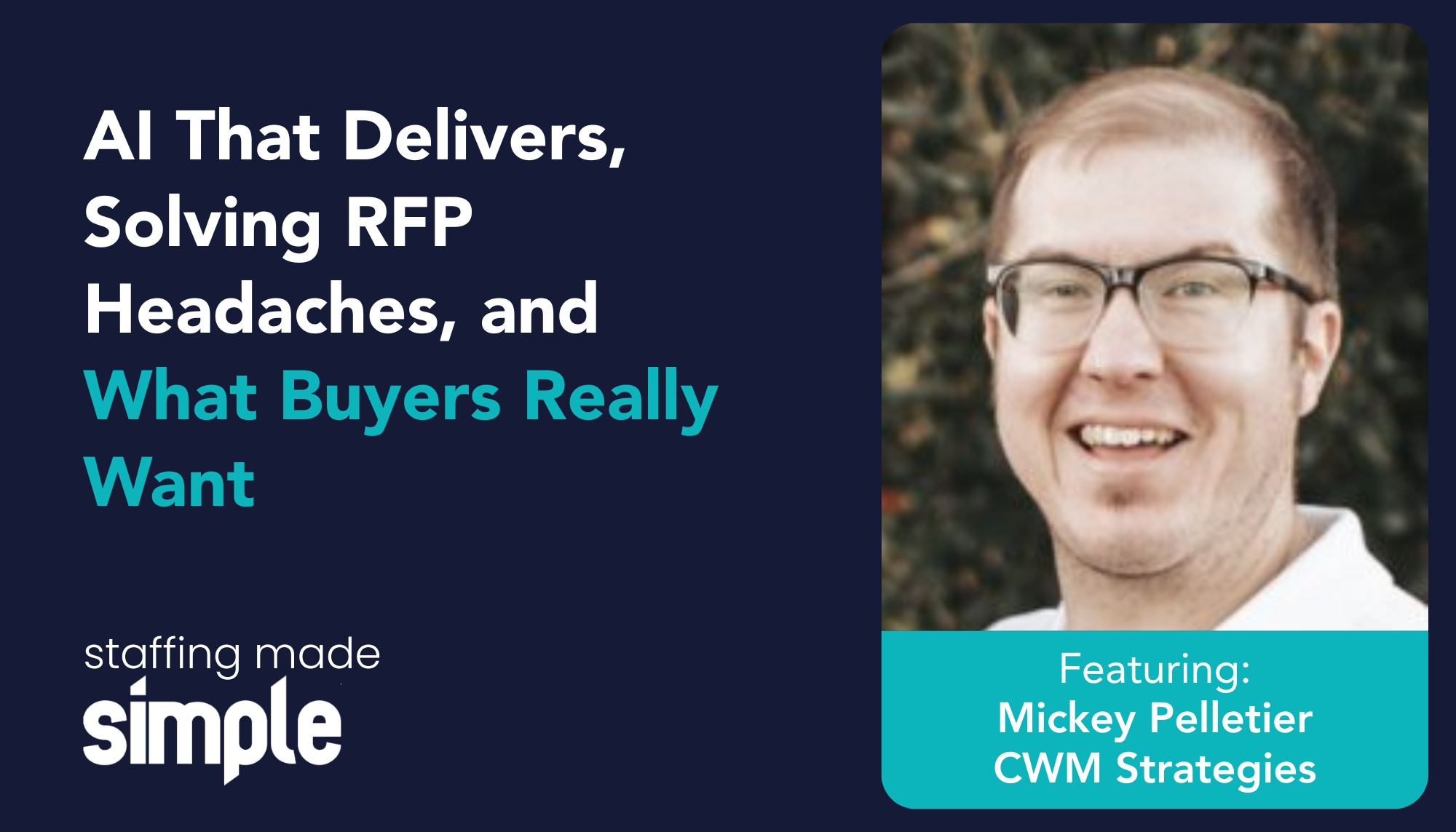
AI That Delivers, Solving RFP Headaches, and What Buyers Really Want
with Mickey Pelletier, CEO of CWM Strategies
The contingent workforce space is full of AI talk, but buyers and staffing firms are still dealing with the same core problem: too much noise and not enough clarity. Firms are trying to stand out, buyers are trying to sort real capability from claims, and RFPs are still one of the most time-consuming parts of the process. So what actually matters when decisions get made — and what doesn’t?
In this episode, co-hosts Rob Geist and Casey Wagonfield sit down with Mickey Pelletier, Founder & CEO of CWM Strategies and cwRFP, to break it down. With 17+ years across MSP, VMS, and the client side, Mickey shares where AI can genuinely help without adding more noise, what buyers actually look for in staffing partners, how firms can differentiate once they’re in a program, and how to make the RFP process less painful for everyone involved. For anyone trying to win more deals, simplify RFPs, or use AI in a way that actually helps, this is a must-listen.
Casey Wagonfield:
If you’re in staffing or you run a contingent workforce program, this episode’s for you. We’re getting real about how AI is showing up in this space right now.
What’s actually useful versus what’s just noise and how to use it without turning into spam. We’re also talking about: What buyers actually look for from suppliers. What makes a staffing partner stand out once they’re in, and why RFPs feel like a painful group project every single time. If you want practical takeaways you can use immediately, stick around.
Rob Geist:
Hello everybody. Welcome back to Staffing Made Simple. I’m Rob Geist, senior vice president at Simple VMS, and today we’re going to talk about a few things everybody’s dealing with right now. AI showing up in temp staffing, what’s real versus what’s hype. How suppliers can stand out without sounding like every other supplier out there.
And we’re going to talk about RFPs because if you’ve ever lived through one, you already know. As always with me today, my co-host, Casey Wagonfield, a guy, with a lot of staffing knowledge, and a little better golfer than I am, and he’s never seen a microphone that he didn’t like.
Casey Wagonfield:
Well, hey, at least you admit it now. This one’s going to be a good one. Like Rob said, we’re hitting AI from both sides. What buyers want to see inside contingent workforce programs, and how staffing firms can use AI without getting lazy or spammy.
We’re going to get into what makes programs run smoothly in the real world. Manager behavior, supplier performance, and we’ll wrap up with some RFP segment because buyers and suppliers both want that process to suck less. So, with that said, we’re going to bring in our guest, and I’m pumped for this one because today we’ve got Mickey Pelletier. Mickey’s the founder of CWM Strategies, an Independent Consultation and Advisory to help clients build and evaluate their contingent workforce programs. And cwRFP, which is a much-needed RFP response platform for the contingent workforce industry. He spent 17 plus years designing, implementing, operating and scaling contingent workforce programs. And he’s done it basically across every seat in the ecosystem.
So MSPs, VMS, providers, and the client side, what I like about Mickey is he doesn’t just talk theory. He’s really big on change management. Simplifying what actually works, cutting through the noise and the busy work, that makes programs harder than they need to be.
He also brings some personality to this industry. If you don’t follow Mickey on LinkedIn, you need to, he is not afraid to mix real talk with humor. Mickey, welcome to Staffing Made Simple.
Mickey Pelletier:
Gentlemen, thanks for having me here. You know how to make a man blush. What an intro. Thank you so much, so glad to be here.
Casey Wagonfield:
When I say, “follow Mickey on LinkedIn”, the first time I saw you on LinkedIn, it was like the Goosebumps series. You did like, a thing on goosebumps, like the RFP nightmare, right?
Like a play on goosebumps. It was nostalgic for me, just reading goosebumps as a kid.
Mickey Pelletier:
It’s the nuance and nonsense of our industry. It’s what I call it. Try to make light of it, because we take ourselves pretty seriously, but at the same time, we have got to poke at ourselves a little bit, poke at our industry and try to have a little fun with it while we’re getting some work done along the way.
Casey Wagonfield:
Yeah, I get it. And I know Mickey, you’re big into AI. You, talk about it a lot. You write blogs about it. And I just kind of want to define this for people, because you know, when people say like AI application in a contingent workforce program, can you just kind of explain to people what that means?
Mickey Pelletier:
Yeah, give you a real simple definition. I kind of think of it as two different things, depending on what you’re saying. The AI application itself, the tool you’re using, but then there’s also the actual, how you’re applying AI to problems and tasks. So, it could kind of mean two things, depending how you’re talking about it.
Rob Geist:
If you were consulting with a buyer of staffing, of contingent workforce today, and you walked in and you thought, okay, where could AI make an impact first and bring real value?
Mickey Pelletier:
Yeah, I mean, without knowing a company right off the bat, two things that I think where AI can really make an impact is, some sort of AI assisted, you know, RFP and supplier evaluation.
You think about the amount of time procurement, MSP times, I don’t want to say waste, but spend on, tracking RFP responses, scoring them, supplier benchmarking, you know, all of that can be quite the effort. Obviously, AI could parse those requirements and surface relevant prior answers from a knowledge base, flag some inconsistencies and really help them.
I think with humans in the loop, layered on top, that can really cut down that time to get to a meaningful outcome. Yeah, I think a second place is really in that job requisition intelligence and demand intake. You know, that workforce decisioning, what are the problems you’re actually trying to solve with talent?
And, that type of demand shaping, at the intake stage, I think instead of reacting to them. You can more proactively do that. And I think that’s a use case that directly touches compliance, cost, speed, and a lot of the things that we look at in programs.
Casey Wagonfield:
Yeah. And I’ve noticed too, especially from the staffing side, a lot of agencies we’ve talked to are investing in the AI that does the busy work for them, right? Helps them focus on actually recruiting for their clients versus data entry and things like that. So, starting there, I think especially from the staffing side, there’s just so many options for AI.
I think a lot of people just get overwhelmed. They’re like, where do we even start?
Mickey Pelletier:
Certainly, there’s a lot of drudgery it can take away and, so yeah, without a doubt, there’s a couple different places I think you can really start. It’s all about making things less painful, but it always comes back to, what are the problems you’re trying to solve?
And then what’s the actual right way to apply AI? And it’s becoming overwhelming. There’s a new tool, a new release, a new 4.6., 4.7, that you see from some of these tools coming out every day. and I try to break it down there’s sort of three main uses of, AI. Some of them have been around longer than we’ve seen.
You think about automation. Rules-based thing. It does exactly what you tell it. Like, hey, every time an invoice arrives, you extract a field and route to an approver. That’s not terribly new. That’s been around for a while. A lot of VMS technology is based around that and that automation is a form of AI.
And then we’ve seen predictive AI, which is you learning from historical data patterns to forecast outcomes like this. Requisition has a 73% chance of going unfilled because of the rate, location, or title. And then what we’ve really seen, which has allowed AI to take off in the mainstream, is generative AI, which is creating that context of text, code, images, kind of by learning the underlying structure of data.
So, I think that’s where it gets a little muddy, it is that the modern product layers all three of these together. And so, a good platform might use automation to trigger a workflow, predictive AI to flag a risk, and then generative AI to draft a communication about it. So, when vendors say AI, it could often mean one or all three interchangeably, and that can get incredibly confusing.
Meanwhile, you just want to make sense of, how can I make my life easier and get things done faster?
Casey Wagonfield:
There’s just so much out there right now, and every day it seems like some new product is coming out. I was like, man, I’m still trying to figure Claude out, let alone the 18 other things that just came out today.
Mickey Pelletier:
Absolutely.
Casey Wagonfield:
So, everybody’s looking at AI, obviously it’s changing daily. But obviously there’s some things especially within a contingent workforce program that have to be human, right. There’s some things that a human has to take over this. What are things that AI just can’t take over? Like they have to have that human touch.
Mickey Pelletier:
So, I think one thing about our industry: it’s human based, right?
And I think that’s one thing, I won’t say it protects us flat out from AI, but it’s a human industry. We’re putting humans to work here and there’s a lot of relationships involved. So, there’s certain things where AI can augment and boost, but it can’t take away.
Things like supplier relationship decisions. You can’t just go and offboard a long-tenured supplier, renegotiate a partnership. You can use it to help with some of the data and the metrics behind it. It can inform, but the human needs to own that conversation, and the judgment call around that.
Speaking of judgment calls, you know, misclassification, when a worker is on the line between contractor and employee. That decision carries legal, financial, human consequences. The AI could flag it, but a human really has to make that decision.
I think culture, change, transformation; that’s something where you have to build trust and credibility with the stakeholders. You could have the fanciest AI suite of tools, no algorithm or anything is going to fix broken trust. So, I think someone has to really walk the floors, build credibility, and be able to, again, have that relationship, which ultimately builds that trust.
Rob Geist:
Absolutely. Love it. And now I’m a big proponent of using it to supplement human stuff because I’m just a relationship person, being in sales. So, it is scary to a lot of people, I think. But it is also good because all the experts on AI that have come in here, they’ve all said things like, yeah, this is just to supplement what the humans are actually already doing and make them more efficient.
So, if you were evaluating someone’s staffing program like a buyer, what are the biggest signals that tell you it’s a truly healthy program? What metrics or behaviors tend to be the biggest truth tellers when it comes to that?
Mickey Pelletier:
Yeah. I think healthy is subjective. I think maturity is more a myth than an actual like marker that we need to move to.
You know, I think that the important thing is that you have benchmarks, and you know what something looks like. But at the end of the day, all that matters is: are your managers and business getting the talent they need at the right rates compliantly? Is your program able to move ahead?
I think we’ve put a lot of stock in oh, you’re only a level four, you’re a Gen three, you’re a Gen Four or a Gen One program.” And that’s fine, I guess. But what matters is, are you solving the problems and do you know what the problems are that you need to solve? And then are you building around that?
I think one of the biggest things that we lack in this industry is the right representation, at the leadership table from a contingent workforce perspective, you see, companies, 30, 40, 50% of their workforce is made up of non-employee talent yet you have a program team of two or three plus an MSP managing all that.
Yet, how much of the people represent HR, and the whole FTE side of it. So, I think that maturity is one way to look at it, but it goes back to, finding out what are the priorities that you have and what means the most to you. And you could have anything you want, but you can’t have everything you want.
You have to prioritize and make sure that you’re doing the right thing for your company to get where you need to go.
Casey Wagonfield:
Yeah, what’s Mark Winter’s saying, Rob? You can have; there’s three things. You can only have two of the three, right? Price.
Rob Geist:
Quality, speed, I think it was. Pick which two you want.
Casey Wagonfield:
One of your blogs, Mickey, I was reading, the work between the work you talked about where you basically said contingent workforce programs have a visible layer and a hidden one. Really good article. Listeners should go check that out but maybe explain that.
Mickey Pelletier:
I was just sort of touching on the contingent workforce program being underrepresented, undervalued, sort of an unsung hero. They do a lot of these external things that people see. They work through the requisitions, submittals, interviews, placements, reporting, invoicing, things like that.
But there’s a lot of stuff that just goes on behind the scenes that can be a lot of busy work, a lot of tactical work of just continuing to move things through the process. Cleaning up incomplete wrecks, explaining policy to a hiring manager and coaching suppliers on submittal quality, fixing data inconsistencies.
So, over time I think you’re just repeating yourself over and over and over. And it’s not like child rearing where eventually your children get it. You get it through the one manager and then you move on to the next manager and then those managers leave and the next ones move on.
And it just becomes a very, cyclical thing of explaining the same thing, doing these same tasks over and over, being very tactical versus less strategic. And I think, that’s one thing I don’t know that a lot of people realize if they’re not from the industry, we all know it because we see it, we talk to, people on the buyer side that experience that day to day. And it’s just an observation that I think is worthy of people’s attention in our space.
Casey Wagonfield:
Absolutely, and one of the things I wanted to ask you is we just actually released an episode with Meea Evans-Cone, probably know her from CEVA Logistics.
We’ve had multiple buyers on show here, and we’ve had different things people have talked about, what seems to be trending is multi-site programs, what works, right? Is it a big national program supplying it? Is it local companies in the markets that you need them? Is it a hybrid of both?
And from what I’ve seen, we do need a hybrid of both, right? Because you might have one agency filling all your positions, but if that one agency in this one market isn’t very good, we need to be able to use that local touch. I’m curious what your thoughts are about that.
Mickey Pelletier:
Yeah, I mean, coming in from the outside, I always think the data should speak for itself.
Performance metrics, mixed with the relationship trust that have been built should be that answer. And really to show what’s working for you now. But you should still think of the future and if your needs change and if you don’t have good data, particularly if a program that’s just getting launched, I think that hybrid approach is sort of a good default starting point.
You’ll leverage the big dogs, the tried and trusted names that you’re a generalist and sort of can service, anywhere and anything. But then also look at those localized niche providers, whether that’s a specific skillset or specific market, and then see how they perform.
Let the data tell the story. I also think the relationships are important. If the relationship’s really strong and it’s also a strong performer, man, mixing the performance data with the relationship, there’s a lot of trust there. And those end up being the strongest performers.
So, I think there’s a lot of factors to look at. And again, going back to you got to find out what works for you and understand what’s the most important.
Casey Wagonfield:
Right. That used to drive me crazy when I was in staffing and selling you. I’d go to this massive company that’s got 60 sites and they’re like, well, we have to use this one agency.
It’s a big national agency or something. They’re like, but we would love to use you if we could. They’re not getting us the people.
Mickey Pelletier:
But a lot of times they can’t work outside of that. It’s kind of like you get what you get. That’s why I always thought.
Casey Wagonfield:
I don’t know why companies aren’t doing more of a hybrid type of, and to your point, something that we talk to people about is when you have that data, you have a VMS that shows the time to fill, time to submit, turnover percentages, things like that. Now you can actually hold people accountable and see what works and what doesn’t and, go from there.
Rob Geist:
So, Mickey, when you sat in the buyer’s seat and you had staffing salespeople reaching out to you all the time, what immediately made you tune them out?
What actually gets your attention? And then two-part question, if you had any advice to stand out to buyers, what would that be?
Mickey Pelletier:
Yeah, I mean, it’s tough because it’s a saturated market. There’s what, 25,000 staffing providers in America, or maybe it’s North America, but still, that’s a lot considering, fortune 5,000 companies.
That puts five suppliers per company with just the most basic math there. So, there’s only so many ways to provide talent. There’s only so many ways to reach out to people, right? So how do you really differentiate? That’s the million-dollar question. And, the bland generic outreach, that shows they don’t really know much about me, the company or the program.
They just want to say what they do, but not how they solve my problems. We heard stories at Procure Con last week of folks, reaching out to a light industrial company talking about clinical healthcare positions. And it’s just like, what are you doing?
And so, everybody had a good laugh. So, making sure you do your research, I think, is the most important thing. And I always struggle with the idea that like, oh, these people are only reaching out because they want my business.
And I know you can’t avoid that. But I never really like that feeling. And I’m only worthy of attention because I have business to give at the time. So how do you avoid that? It goes back to being genuine and authentic.
And yeah, maybe something can work out, but you and I all know this is a long game, in the industry. Sales take years to take place. So, playing the long game, having genuine relationships, researching, understanding the needs, and understanding what the problems are, and if they say no or, hey, try again later.
You back off and you’re attentive to that and, just, be a good person about it. And it’s a balance. It’s a balance. I want to stay top of mind for you, but I don’t want to be a nuisance.
Casey Wagonfield:
Don’t a restraining order, but I want your business.
And it’s funny you say that. I don’t like that feeling like they’re just reaching out to me because they want my business. But I think that’s where somebody is truly, personalizing and doing their research and really says something that you’re like, wow, how did they even know that?
That’s the things to me that would catch somebody’s attention or would catch my attention being different than just sending you a big salesy, text-y email that’s a book that you’re not going to read and delete, right?
Mickey Pelletier:
Right.
Casey Wagonfield:
Send a personalized video or send something that is going to stand out.
We had a guy on our last episode, Dale Dupree. He’s awesome. I follow on LinkedIn. He runs a company called The Sales Rebellion, and it’s all about getting people curious, making them feel something. Because to your point, there’s 25,000 agencies out there and they’re all going after the same people.
So, if you’re not doing something to make them feel something or make them remember you, then you’re just going to look like the rest of the thousands of agencies that are calling every day.
Mickey Pelletier:
Yeah, it’s a busy, saturated market out there and there’s consolidation going on and the industry ebbs and flows.
So, it could be a tough one to be out there to make yourself unique.
Casey Wagonfield:
Yeah. And I’d say probably the hardest part for staffing companies and especially sellers, is getting the meeting right. If we can get to the meeting, we feel like we can sell it, and we can get the business.
But, you know, as somebody who has overseeing programs, once a supplier is in, they’re in the program, what keeps them there long term?
Mickey Pelletier:
I mean, I think it’s pretty simple, pretty straightforward: performing well, doing well, being a good partner, following the rules, being proactive and showing up when they’re supposed to, but also providing feedback of “Hey, this is, going well, this isn’t.” And just bringing things that are meaningful to the client-side leader. I don’t know that there’s any special trick there but just being a good partner. What do they say as a child, treat people the way you would want to be treated. If you were in that seat, how would you want it to be?
Rob Geist:
I had a client of mine not too long ago that told me, “Rob, tell these suppliers I want to have a relationship with somebody in leadership, not just the recruiter as well.” And then if that person if’s doing a great job for you, who’s recruiting ends up going somewhere else, it’s easier to replace them and not have a disruption in service.
If there’s somebody in leadership that’s actually got a relationship with the client and knows what the needs are. It’s just the simplest thing. You kind of said it’s like everything you learned in kindergarten, that’s literally all you need to do to be successful in this industry.
And I think we mystify, a lot of it. And going to the RFP topic, everybody’s been in an RFP and my biggest frustration with RFPs is I do it and I spend all the time doing it. And then the client doesn’t make any decision using the RFP responses, which happens often, surprisingly.
But what do you think the biggest mistake suppliers make in RFP responses and what do the best ones do differently?
Mickey Pelletier:
I think the ones that do well are authentic and they actually answer the question directly. Like, let’s not add too much fluff. Let’s just get to the point.
I think when you struggle, it’s like you don’t understand the actual problem and then you just end up serving up a, generic sort of canned answer that you had your favorite AI thing write for you versus actually speaking from, the heart of your knowledge base of what makes your company, your company.
And to me, great responses factor in the client’s needs, their priorities, they speak to how their problems are solved. Like I said, it’s not rocket science. It’s pretty straightforward and we all know the RFP space can be a little bit of a game.
Rob, you just talked about it, take the time to put together this response and then you hear crickets. So, it could be a disheartening game to play.
Casey Wagonfield:
Yeah. That leads perfectly into our last questions here and our last piece. cause as the founder of cwRFP, what problem in the RFP process frustrated you enough that you built this in the first place, and were you seeing it over and over made you realize that there had to be a better way?
Mickey Pelletier:
Yeah, I mean, it’s funny like what, what you just cited there is sort of the reasoning behind it. You know, having just these sorts of generic, canned answers that are just not very specific. Like we said, it’s a game that we all have to play, but if we’re going to play it, let’s make it a little bit easier.
So, I created this cwRFP, which is a response tool built specifically for our industry, and allows you to turn your past proposals into client specific answers using a knowledge base you create based on your past answers and we’ll analyze your RFPs and allow you to provide client specific answers.
And it’s not just like a Chat GPT wrapper, it’s using your knowledge base to generate these answers and giving you citations, letting you know where in your knowledge base it’s coming from. And so, it could take out some of that drudgery, that administrative burden, that repetitive work and allow you to process and respond to RFPs in days instead of weeks.
And more consistent quality answers. And, you don’t have to always rely on SMEs that know everything, to be a bottleneck, and you just have that centralized knowledge base. And, now everyone, I think, can compete a little bit more equally on RFPs with the technology. So, that’s what I’m going for.
Thanks for giving me a minute or two to talk about it here because I think it’s something that we need and folks could use.
Casey Wagonfield:
Yeah. Long overdue, man, just from doing RFPs back in staffing where you had, I had an 86-page word documents. Some of the answers are five years old, some of them were last month.
It’s like filtering through and then just picking and choosing what you needed, so yeah.
Mickey Pelletier:
Let’s say that I do that for you and just make it easy for you. And then human in the loop, you validate everything and you’ll get there a lot quicker.
Casey Wagonfield:
Yeah. And for anybody listening, definitely check it out and reach out to Mickey.
I’ve seen it, it’s. slick. He has done a really good job putting this thing together and it’s only gotten better. I’ve seen some updates that you’ve done and made some changes since the last time, I’ve seen it, so, awesome to see.
Mickey Pelletier:
Thank you.
Casey Wagonfield:
And Mickey, we appreciate you coming on spending some time with us today. Where can listeners find you and learn more about cwRFP?
Mickey Pelletier:
Yeah, cwrfp.com or look me up: Mickey Pelletier on LinkedIn and would love to connect with you and chat all things RFP or just, talk shop on anything in the industry in general.
Rob Geist:
Thanks again, Mickey. That’s a wrap for the show.
Big thanks to everyone who listens to Staffing Made Simple. If you’ve got any value from this episode, do us a favor, follow the show, leave us a quick review and send it to a person who might learn something from hearing it. And if you’re a buyer of staffing or a staffing agency who needs a VMS partner trying to simplify how to manage contingent labor, check out simplevms.com and connect with us on LinkedIn. We will see you guys’ next time.